
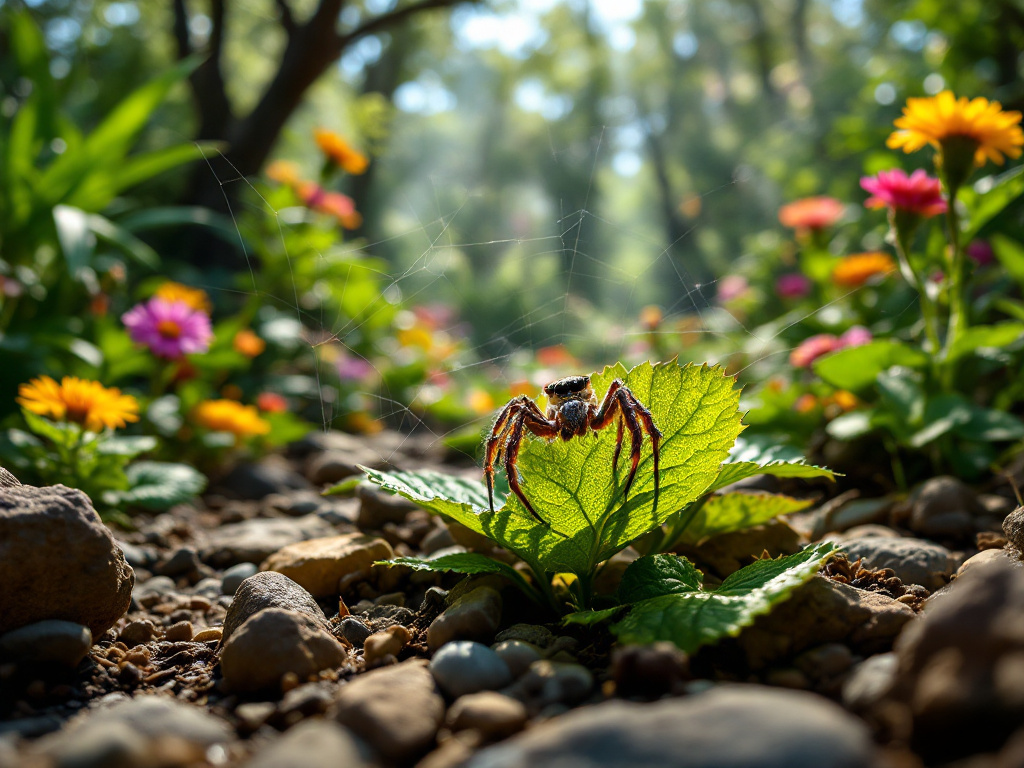
Image generated by flux-ai.io & content generated by ChatGPT Version 4o-mini
Jumping Spiders: Nature’s Little Helpers in Suwannee County
Residents of Suwannee County, Florida, may not think much about the eight-legged creatures scuttling around their gardens or parks, but a recent study on the common jumping spider, Maevia inclemens, reveals that these little predators play an essential role in our local ecosystem. Understanding their behavior and benefits can help us appreciate the biodiversity right in our backyards.
Maevia inclemens is a type of jumping spider found throughout eastern North America, including our beautiful tree lines and trails. You might spot them on vines and even on those pesky poison ivy plants that many of us try to avoid. These spiders are particularly interesting because the males come in two distinct forms, known as dimorphic males. They look different and behave differently when courting females—a bit like how some local people might dress up differently for a special occasion.
What Makes Them Special?
The male Maevia inclemens has two morphs: the tufted morph and the striped morph. The tufted males have fluffy tufts of hair and are darker in color, while striped males have distinctive stripes and a lighter appearance. What’s remarkable is that both types of males exist in equal numbers, and it’s still a mystery why some males become tufted while others become striped. This variety is similar to how some Suwannee residents might have different hobbies or careers; both contribute to the community in unique ways.
When it comes to mating, these spiders perform different dances to attract females. Tufted males court from a distance, showing off by standing tall and waving their abdomens, while striped males get closer and move back and forth. Much like a local dance-off, each male tries to impress the female, but interestingly, females don’t seem to prefer one type over the other. This behavior helps keep the genetic diversity of the species strong, which is vital for their survival.
Why Should We Care?
You might be wondering, why does any of this matter? Well, jumping spiders like Maevia inclemens are excellent pest controllers. They are carnivorous and feed on a variety of small insects, including pests that can harm our gardens and crops. For farmers and gardeners in Suwannee County, having these spiders around can reduce the need for chemical pesticides, making food production more sustainable.
Moreover, jumping spiders are not just good for pest control; they have also been found to contribute to the pollination of certain plants by feeding on nectar. This means they can help with the growth of plants that are important to our local ecosystem and economy, including those grown on small farms or in home gardens.
A Community Connection
For the residents of Suwannee, understanding the role of Maevia inclemens can help foster a stronger connection to the natural world. By recognizing that these tiny spiders are beneficial rather than harmful, we can create a more harmonious environment in our gardens and neighborhoods. Instead of reaching for a can of bug spray at the sight of a spider, consider letting them hang around and do their job.
As we enjoy the natural beauty of Suwannee County, let’s remember the important roles that even the smallest creatures play in our ecosystem. The next time you see a jumping spider, take a moment to appreciate how it helps keep our community thriving—one insect at a time.
References
EENY-702/IN1209: Dimorphic Jumper Maevia inclemens (Walckenaer 1837) (Arachnida: Araneae: Salticidae). (n.d.). Ask IFAS – Powered by EDIS. https://edis.ifas.ufl.edu/publication/IN1209