
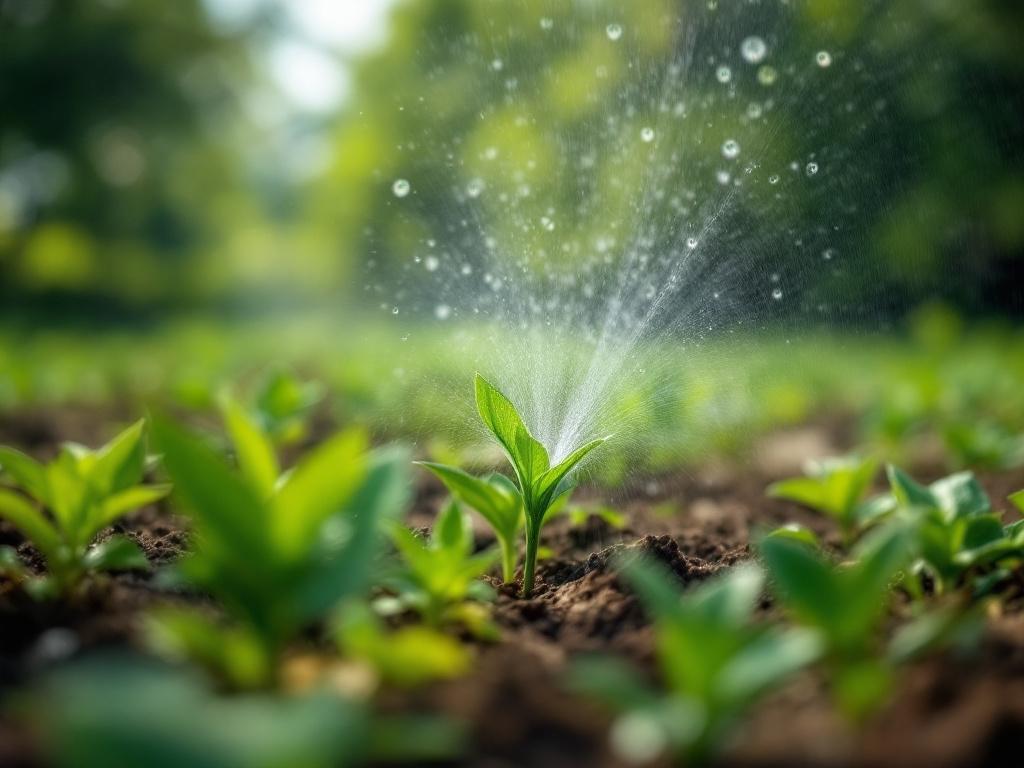
Image generated by flux-ai.io & content generated by ChatGPT Version 4o-mini
Efficient Irrigation: A New Guide for Calhoun County Farmers
As farmers in Calhoun County look for ways to improve their irrigation practices, recent research from the University of Florida’s Institute of Food and Agricultural Sciences (UF/IFAS) offers valuable insights. Understanding how much water crops need can lead to better yields and more efficient use of resources, which is especially important in our community, where agriculture plays a significant role in the local economy.
The study focuses on the crop coefficient, or Kc. The crop coefficient is a value that helps farmers estimate how much water their crops need at different growth stages. This is crucial for effective irrigation, ensuring that crops receive adequate water without wastage.
What is Crop Coefficient (Kc)?
Every crop has a unique Kc value that changes as the plant grows. For example, a newly planted tomato seedling requires different amounts of water compared to a fully grown tomato plant. The research identified typical Kc values for various crops commonly grown in Florida, such as tomatoes, peppers, and strawberries. These values serve as guidelines when local data is unavailable, ensuring that farmers can make informed irrigation decisions.
In Calhoun County, where cotton and peanuts are major crops, understanding Kc can help farmers optimize their irrigation strategies, especially as they face challenges like rising water costs and changing climate conditions.
Why Does This Matter for Calhoun County?
Calhoun County is home to about 200 farms, and agriculture is vital to our economy. With a median household income of around $46,901, efficient farming practices can directly impact local livelihoods. By utilizing the Kc values provided in the study, farmers can optimize their water use, potentially reducing costs and increasing crop yields.
For instance, during the initial growth stage, a crop might only need 40% of the water that it will require in its mid-season. Knowing these specifics allows farmers to adjust their irrigation schedules accordingly, conserving both water and money, which is particularly important in Florida, where water resources can be limited.
Practical Application of Kc Values
The study breaks down the Kc values month by month, allowing farmers to determine their specific crop’s water needs throughout the growing season. For example, a farmer growing tomatoes might find that in the initial growth stage, the Kc value is low, indicating less water is needed. As the plants grow and begin to flower, the Kc rises, suggesting it’s time to increase irrigation.
This practical approach not only improves crop health but also supports sustainable farming practices. By using water more wisely, farmers can contribute to the conservation of local water supplies, an increasingly important issue in our region.
Looking Ahead
As Calhoun County continues to develop its agricultural sector, tools like the Kc values from this research can empower local farmers to make informed decisions. By adopting more efficient irrigation practices, our farming community can thrive while also protecting the natural resources we rely on.
For detailed information on how to implement these findings, farmers can access the full guide from the University of Florida online. By staying informed and adapting new research, we can ensure that Calhoun County remains a stronghold of agricultural production for years to come.
References
AE456/AE456: Evapotranspiration-Based Irrigation for Agriculture: Crop Coefficients of Some Commercial Crops in Florida. (n.d.). Ask IFAS – Powered by EDIS. https://edis.ifas.ufl.edu/publication/AE456